
 Amanda Vitale, Digital Marketing Manager
Why Country of Origin Now Shapes Auto Retail Price Pressure
Pricing trends are widening by country of origin. At retail, those gaps are starting to matter. For decades, German and Japanese automakers have...
Not long ago, dealership visibility followed a pretty predictable formula.
You optimized your website for a handful of high‑intent keywords, invested in Google Business Profile, earned some backlinks, and watched traffic roll in. Ranking on page one meant clicks. Clicks meant shoppers. And shoppers meant sales.
That model worked... Until it didn’t.
Today’s shoppers still search. They just don’t search—or click—the way they used to.
Historically, dealership visibility revolved around traditional SEO:
In that world, success was measured in rankings and clicks. If your dealership appeared high enough on the search engine results page (SERP), shoppers would click through, browse inventory, and convert.
But search engines were never the final destination—they were just the gateway.
Now, they are the destination.
Search behavior has shifted dramatically in the last few years, largely driven by AI‑powered experiences.
Nearly 60% of Google searches now end without a click, meaning the shopper gets their answer directly on the results page instead of visiting a website. Google’s AI Overviews, featured snippets, local packs, and knowledge panels all contribute to this “zero‑click” reality.
At the same time, consumers are increasingly using AI tools like ChatGPT, Google AI Overviews, and Microsoft Copilot to research purchases. McKinsey reports that 50% of consumers intentionally use AI‑powered search, and that AI search is influencing buying decisions across the entire journey, not just at the research stage.
For automotive specifically, this matters because:
Over 90% of car buyers research online before visiting a dealership.
Buyers arrive more informed, further down the funnel, and with fewer website visits than ever
Visibility today isn’t just about being clickable. It’s about being referenced, summarized, and trusted by AI.
This is where new acronyms enter the conversation.
SEO (Search Engine Optimization)
SEO still matters. It’s the foundation that helps your dealership website get discovered, crawled, and understood. Strong SEO supports rankings, local visibility, and content authority, but it’s no longer the end goal.
AEO (Answer Engine Optimization)
AEO focuses on optimizing content so it can be used as an answer by search engines and AI tools. This includes:
When a shopper asks, “Which SUV is best for winter driving?” AEO determines whether your dealership’s content becomes part of the answer even if no one clicks.
GEO (Generative Engine Optimization)
GEO extends visibility into AI‑generated experiences like ChatGPT, Google AI Overviews, and Copilot. These tools don’t rank websites; they cite and summarize sources.
In other words, SEO gets you indexed.
AEO helps you get answered.
GEO helps you get mentioned.
Together, they shape how shoppers discover dealerships at every stage of the journey—from early research to final decision‑making.
One of the most common reactions to these changes is: “SEO is dead.”
It’s not.
What’s dead is the idea that rankings alone equal visibility.
Search engines and AI models still rely heavily on well‑optimized, authoritative websites. In fact, websites with strong organic visibility are more likely to be cited in AI‑generated search results.
Another misconception? That AI visibility is out of a dealer’s control.
In reality, dealerships that invest in structured content, clear expertise, and consistent digital signals are far better positioned to show up—both in traditional search and AI‑powered answers.
The rules of visibility have changed, but they aren’t a mystery.
Dealers that understand how SEO, AEO, and GEO work together can position their brand to appear where shoppers are actually looking today: AI answers, summaries, and recommendations.
We break down exactly how to do that—step by step—in our latest dealer guide.
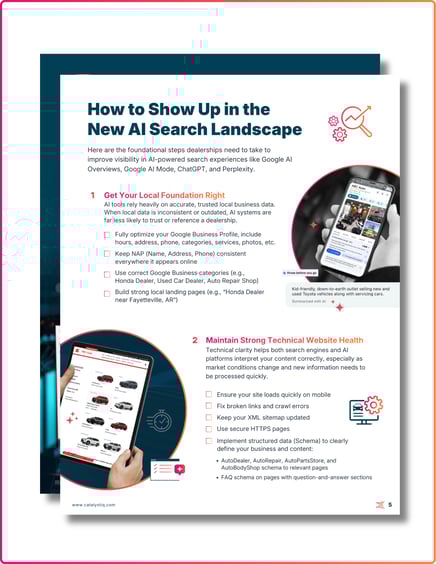
Inside, you’ll find a practical checklist that shows dealerships how to:
The dealerships that adapt now will be the ones shoppers see, trust, and choose next.

About Catalyst IQ
Catalyst IQ is an integrated automotive marketing platform that helps dealerships make smarter decisions and sell more cars using real-time data, AI-powered insights, and expert human support. From digital advertising and web presence to SEO/AEO and engagement, every solution works together to drive measurable growth.

Pricing trends are widening by country of origin. At retail, those gaps are starting to matter. For decades, German and Japanese automakers have...

Not long ago, dealership visibility followed a pretty predictable formula. You optimized your website for a handful of high‑intent keywords, invested...

Historically, the gold-standard for measuring dealership marketing performance has been lead volume. These metrics are easy to measure, simple to...