
 Rick Wainschel, VP Data Science & Analytics
Automotive Digital Marketing Solutions: Digital Advertising and SEO
Long before they reach your lot, shoppers are seeing your inventory in ads and searching for answers online. This guide shows how digital...
Pricing trends are widening by country of origin. At retail, those gaps are starting to matter.
For decades, German and Japanese automakers have benefited from something incredibly powerful in the U.S. market: Permission to charge more.
That permission was earned through engineering credibility, performance reputation, durability narratives, and brand equity built over generations. Consumers did not just buy these vehicles. They justified them because the premium was part of the story.
But premiums only work in the right environment. And that environment is changing.
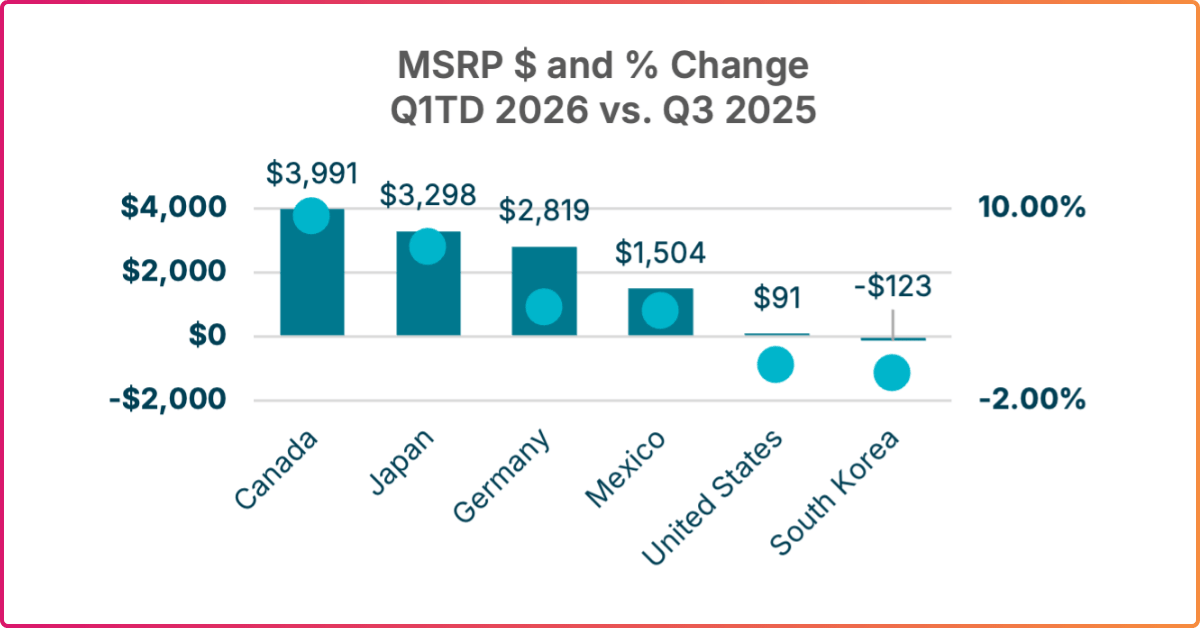
Through February 9, 2026, MSRP and average marketed prices for vehicles produced in Canada, Germany, and Japan are rising at a meaningfully steeper rate than vehicles produced in the United States, Mexico, or South Korea relative to Q3 2025 levels.
On paper, that’s a pricing trend.
On the showroom floor, it’s something much more tangible. It’s a payment gap. And payment gaps feel very different when consumer confidence is soft and affordability is already stretched.
.png?width=1200&height=628&name=The%20Retail%20Impact%20of%202026%20Auto%20Tariffs%20Feb%202026%20(2).png)
Dealers are operating in a retail market where customers are more cautious, more payment‑sensitive, and more analytical than they were even a year ago. When confidence declines, elasticity tightens. Consumers become less willing to stretch for aspirational upgrades and more inclined to rationalize toward value.
This is where tariffs begin to matter. Not as policy, but as pressure.
If German and Japanese manufacturers are absorbing more structural cost into their vehicles, and that cost is flowing through to MSRP and marketed price, the premium narrative has to work harder. The question quietly shifts from “Is this better?” to “Is this better enough?”
That shift is subtle. But at retail, subtle shifts compound.
A $50-$100 monthly difference can redirect a buyer. Not dramatically or ideologically. Practically.
And when high prices intersect with low consumer confidence, brands carrying more embedded cost face a double headwind. They aren’t just managing affordability challenges common to the industry. They’re managing relative affordability challenges versus competitors whose production footprint is less exposed.
South Korean and U.S.‑produced vehicles, by contrast, have not experienced the same upward pricing acceleration relative to Q3 benchmarks. That stability creates breathing room at retail.
It preserves flexibility in structuring deals, protects advertised payments, and sustains competitiveness in high‑volume segments where small differences can convert to measurable share shifts.
For dealers, this isn’t theoretical.
If certain country‑of‑origin vehicles continue to climb at a faster pricing trajectory, retailers may begin to see more intra‑segment substitution, sometimes within brand families and sometimes across them.
A customer who once stretched for engineering prestige may instead prioritize total cost of ownership. A buyer who once defaulted to brand loyalty may increasingly shop payment‑first.
None of this suggests that German or Japanese brands lose their equity overnight. Brand strength is durable. But elasticity is situational. And today’s macro environment rewards pricing stability more than aspirational stretch.
Tariffs, in this context, are less about politics and more about positioning. They are quietly influencing which brands have room to maneuver and which are forced to defend.
For retail operators, the implication is clear. Country of origin is no longer just a manufacturing detail. It is increasingly a retail variable.
The brands absorbing more cost will need sharper value articulation, more precise inventory management, and potentially more strategic incentive deployment to offset widening payment spreads. The brands insulated from that pressure have an opportunity not just to hold share, but to capture incremental consideration in an affordability‑driven market.
The competitive map isn’t being redrawn overnight. But it is being nudged. And in retail, nudges add up.
When pricing pressure shifts by country of origin, static strategies fall behind. Dealers need to understand where payment gaps are forming, which vehicles are most exposed, and how those conditions are changing in their specific market.
With MarketAI®, Catalyst IQ gives dealers real‑time insight into market pricing, demand movement, and inventory risk so they can identify vulnerable VINs, adjust strategy quickly, and activate inventory without waiting on lagging reports.
When the market moves, reacting late is costly.
See how Catalyst IQ helps dealers respond to pricing pressure in real time. Schedule a demo today.

About Catalyst IQ
Catalyst IQ is an integrated automotive marketing platform that helps dealerships make smarter decisions and sell more cars using real-time data, AI-powered insights, and expert human support. From digital advertising and web presence to SEO/AEO and engagement, every solution works together to drive measurable growth.

Long before they reach your lot, shoppers are seeing your inventory in ads and searching for answers online. This guide shows how digital...

Model Year Changeover season is here. And for dealers, waiting to support 2026s could come with a significant price tag. We are officially...

No one can tell you what your dealership's marketing will cost before looking at your market. What you spend depends on your local competition,...