
Digital Marketing for Car Dealerships: How Real-Time Intelligence Separates the Winners (2026)
Car dealerships face a marketing challenge unlike almost any other industry. Inventory changes daily. Buyer intent spikes and fades in hours. A single misallocated ad budget can mean paying to promote a vehicle that already sold or pouring spend into a slow-moving unit while high-demand cars sit without visibility.
Digital marketing for car dealerships in 2026 is not about running more ads. It is about running smarter ones powered by real-time data that reflects what buyers actually want, what your competitors are doing, and which units in your lot need the most attention right now.
Catalyst IQ was built for exactly this environment. Our MarketAI® engine reads live market signals (demand shifts, inventory aging, competitor pricing) and activates the right message, on the right channel, at the right moment. The result: dealers move more inventory, waste less budget, and finally have clear visibility into what is driving results.
This guide covers every dimension of car dealership digital marketing, from advertising and SEO to AI-powered market intelligence, and shows how growth-minded operators are using it to outperform their market in 2026.
What Is Digital Marketing for Car Dealerships and Why Does It Look Different in 2026?
Digital marketing for car dealerships is the strategic use of online channels (search advertising, social media, display, video, SEO, and email) to attract in-market vehicle buyers, engage them across their purchase journey, and convert them into showroom visits and sales.
But the definition only tells half the story. What has changed in 2026 is how those channels work and who wins by using them well.
The Old Model: A dealership allocated a fixed monthly budget across a handful of channels (Google Ads, Facebook, maybe a display campaign) and waited for the monthly report to find out what happened. Campaigns were built around makes and models, not individual units. Inventory feeds updated slowly. By the time the data came in, the market had already moved.
The 2026 Model: Leading dealerships use real-time data to make decisions at the speed of the market. MarketAI processes these signals through a real-time automotive demand analysis engine that scores every VIN on the lot based on current market conditions. Campaigns activate and adjust automatically when inventory changes. SEO and AEO strategies are built to appear not just in Google search results, but in AI-generated answers because that is increasingly where in-market buyers are starting their research.
The shift from static, channel-by-channel marketing to a unified, real-time intelligence approach is the single biggest competitive separator in automotive retail marketing today. Dealers who have made this shift report faster inventory turn, lower wasted spend, and better lead quality. Those still running the old playbook are competing with one hand tied behind their back.
Your dealership's website platform is the foundation of everything; the hub all your digital marketing channels drive traffic back to. Getting it right is non-negotiable before any channel investment makes sense.
What Digital Marketing Channels Should Car Dealerships Be Using?
There is no shortage of channels available to dealerships. The question is not which ones exist - it's which ones are pulling from the same live data source, and which ones are running in silos.
Here is how each channel plays a role in a complete car dealership digital marketing strategy:
Search Advertising (SEM / Google PMax)
Put your inventory in front of buyers at the exact moment they are searching. Search campaigns for dealerships should update as vehicles sell, suppress spend on out-of-stock VINs, and drive traffic directly to vehicle detail pages (VDPs). VIN-specific digital advertising powered by live inventory data outperforms static campaigns in both click-through rate and conversion.
Google Vehicle Listing Ads (VLA)
Google Vehicle Listing Ads for dealerships surface specific inventory units directly in Google search results (with photo, price, and availability) before buyers even reach your website. For in-market shoppers, this is one of the highest-intent placements available.
Google Vehicle Ads have become one of the highest performing paid channels for dealerships because they display actual inventory with images, pricing, and dealer name directly in search results. Unlike traditional search ads, Vehicle Ads connect individual VINs to high intent shoppers at the moment they're searching. Catalyst IQ's VINScore technology takes this further by scoring every VIN in real time so ad spend flows to the vehicles with the strongest demand signal. Learn how to optimize Google Vehicle Ads with VIN level scoring to lower cost per click and move inventory faster.
Display and Programmatic
Retarget shoppers who visited your VDPs. Reach conquest audiences in your market. Display campaigns are most effective when inventory-aware, showing the exact units a shopper viewed, updated in real time.
Social Media (Facebook, Instagram, TikTok)
Social advertising for dealerships works best for top-of-funnel awareness and retargeting. VIN-level social ads promoting actual inventory with live pricing consistently outperform generic brand awareness creative.
Video and CTV (Connected TV)
Reach in-market buyers on streaming platforms. CTV is growing rapidly as a dealership channel because it combines the reach of broadcast with the targeting precision of digital.
SEO and AEO
Organic search and AI-driven answer engines are long-term assets that compound over time. We cover this in depth in H2 #5 below.
Lead Capture and Nurture
Lead capture and shopper identification closes the loop, turning anonymous website visitors into identified prospects and keeping them engaged through automated nurture sequences until they are ready to buy.
The critical insight: each of these channels delivers average results when operated independently. They deliver exceptional results when they all pull from the same real-time data layer - the same inventory intelligence, the same market signals, the same performance reporting. That is what an integrated approach makes possible.
Read More | What Makes or Breaks a Dealership Website →
What Does a Complete Car Dealership Marketing Strategy Look Like?
Knowing which channels exist is only the beginning. The harder question is how to use them together in a way that actually moves inventory, and that requires a strategy built around one thing some dealerships don't have: A clear picture of which vehicles need help to move and which ones don't.
Every channel in a dealership marketing strategy has a specific job. Paid search captures buyers who are already close to a decision. Display and CTV keep your inventory visible to shoppers who are still in research mode or who visited your site and left without converting. Social ads reach buyers earlier in the journey and bring back the ones who've already shown interest.
None of these channels is inherently better than the others. What separates a high-performing strategy from an expensive one is knowing which job matters most for which vehicle, right now.
That's where inventory intelligence changes everything.
How Do Dealerships Know Which Vehicles to Advertise?
Dealership marketing strategies that work don't treat every vehicle the same. A fresh arrival with strong local demand doesn't need the same advertising weight as a unit that's been sitting for 45 days in a competitive segment. Spending equally across all inventory isn't a strategy — it's a default. Catalyst IQ's VINScore, powered by MarketAI, gives every vehicle on your lot a daily-recalculated score based on real market conditions: How comparable units are moving in your DMA, local supply and demand trends, market aging patterns, and price position relative to your competitive set.
That score becomes the foundation for advertising decisions, determining which vehicles need more support, how aggressively they should be promoted, and where budget should concentrate to create the most impact.
The result is a dealership marketing approach where spend follows opportunity rather than habit. High-scoring vehicles positioned to sell quickly get targeted exposure to close the deal. Lower-scoring units that need a push get more aggressive cross-channel treatment before they age past the point where advertising alone can move them.
.png?width=800&height=800&name=CIQ%20VINScore%20(1).png)
How Shared Data Makes Every Dealership Marketing Channel More Effective
The other thing that distinguishes a real strategy from a collection of campaigns is integration. When your ads are all pulling from the same live inventory and market data, they reinforce each other. A shopper who sees a specific vehicle in a social ad gets a display ad featuring that same unit after visiting your site. A VDP visitor who didn't convert stays in front of that vehicle across the platforms where they spend time, until they're ready to come back.
That kind of coordination doesn't happen by accident. It happens when every channel shares the same data layer, and when the intelligence behind that data is updating daily to reflect what your market actually looks like.
See how VINScore-powered advertising works for your dealership. Request a Demo →
Working with an automotive digital agency that combines real-time data with full-channel execution is what separates dealerships that consistently move inventory from those that perpetually discount to compete.
How Does Real-Time Market Data Make Dealership Advertising More Effective?
This is where most automotive marketing conversations stop being theoretical and start being operational.
Real-time market data in automotive context means knowing right now, not last week, which units in your inventory are aging past acceptable days-on-lot thresholds, which makes and models have rising demand in your specific market, what your local competitors are advertising and at what price points, and which VINs are most likely to sell in the next 72 hours if given proper digital exposure.
What is VIN-level advertising and why does it change everything?
Instead of promoting a brand or model generically ("Great deals on Silverados this month!"), VIN-level advertising promotes specific vehicles from your live inventory with real photos, real pricing, and real availability to buyers who are actively searching for that type of vehicle.
More importantly, it prioritizes which VINs get ad spend based on demand data. A unit that has been on your lot for 45 days gets different (and more aggressive) treatment than a fresh arrival with strong organic demand. Budget flows to where it will do the most work.
The cost of running on static data:
When your campaigns run on a delayed inventory feed, you pay to advertise vehicles that sold yesterday. You run the same spend on a hot unit that would have sold anyway and a slow unit that desperately needs visibility. You have no signal from the market to tell you which is which until the month-end report arrives.
That is not a small inefficiency. For a dealership spending $30,000–$80,000 per month on digital advertising, even a 15% reduction in wasted spend represents meaningful dollars and faster inventory turn compounds that benefit over time.
MarketAI® is the engine that makes this possible.
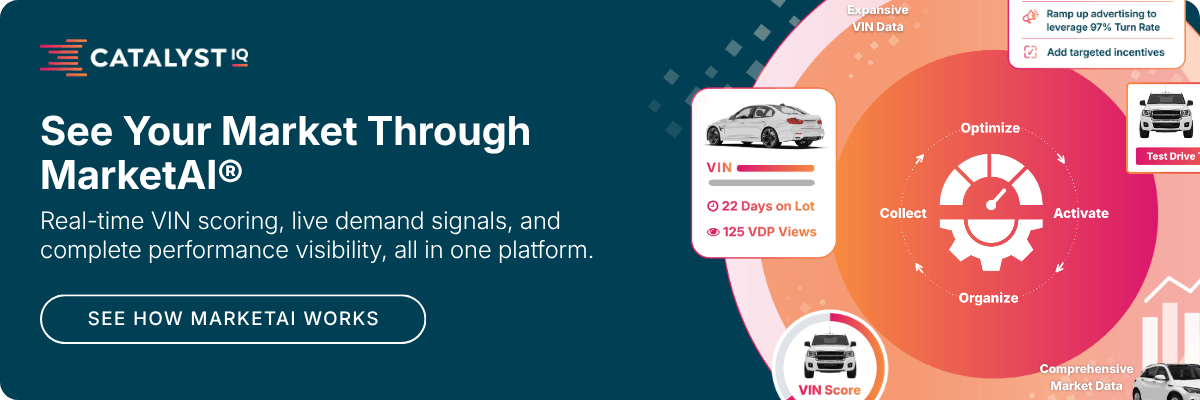
MarketAI® unifies inventory data, real-time market demand signals, and competitive intelligence into a single platform - then uses that intelligence to automatically prioritize, activate, and optimize campaigns across every channel. It scores every VIN. It identifies which units need attention. It launches and adjusts ads in minutes, not days.
The result is advertising that moves at the speed of your market, not the speed of your reporting cycle.
See how MarketAI® works for your dealership →
Understanding market data is only valuable when it leads to action. Automotive analytics platforms close that gap by translating raw demand signals, pricing trends, and competitive data into recommendations your team can execute the same day. See how real time automotive analytics are changing dealership advertising decisions and why static monthly reports are no longer enough.
What Should Car Dealerships Look for in a Digital Marketing Platform?
If you are evaluating automotive marketing software or comparing vendors, these are the questions that separate platforms that move inventory from platforms that just move budget.
Use this as your evaluation checklist:
-
Does it use real-time inventory data, or does it run on a static feed? Any platform still operating on a daily or weekly inventory sync is already a step behind. Real-time means updates in minutes when a vehicle sells, arrives, or changes price.
-
Can it score and prioritize individual VINs for ad spend? Not all inventory deserves equal advertising weight. A platform that treats every unit the same will always underperform one that intelligently routes spend to where it creates the most impact.
-
Does it activate across all channels from one platform or does it require multiple vendors? Every additional vendor in your stack adds cost, complexity, and data inconsistency. A single-platform approach where search, social, display, video, and CTV all pull from the same intelligence layer is significantly more efficient.
-
Does it provide transparent performance reporting from budget to sold units? Vanity metrics (impressions, clicks) are not enough. You need to see the line from ad spend to VDP visits to leads to sold units. If your platform cannot show you that chain, you are operating blind.
-
Is it certified for your OEM program? OEM-certified programs have compliance requirements, co-op funding structures, and reporting standards. Not every platform qualifies. Working with a certified partner means your co-op dollars are protected and your campaigns meet manufacturer standards.
-
Does it support your dealership website and SEO strategy from the same data layer? Your website is not a separate silo from your advertising. The best-performing dealerships run their dealership website platform, their advertising, and their SEO strategy from shared intelligence so every channel is working toward the same goal with the same market context.
-
Does it include AEO, not just traditional SEO? AI search is not the future. It is the present. Platforms that are not actively optimizing your dealership's visibility in ChatGPT, Gemini, and Google AI Overviews are already leaving organic reach on the table.
-
Does it scale across multiple rooftops? If you are part of a dealer group managing multiple locations, your platform needs to handle enterprise-level inventory complexity, cross-rooftop reporting, and market-level intelligence (and not just single-point solutions).
Catalyst IQ, the best full-service digital agency for car dealerships, was designed to meet every one of these criteria. Not as a collection of tools assembled from acquisitions, but as a purpose-built platform where every solution shares the same real-time intelligence backbone.
How Does Catalyst IQ Compare to Other Digital Marketing Platforms for Car Dealerships?
Choosing the top digital marketing agencies for the automotive industry means understanding how vendors differ on the capabilities that actually move inventory. The table below compares Catalyst IQ to three widely used platforms across five areas that matter most to dealer marketing teams: real time data depth, VIN level activation, OEM program support, integrated website platform, and reporting transparency.
| Capability | Catalyst IQ (MarketAI) | Fullpath | DealerOn | PureCars |
|---|---|---|---|---|
Real Time Data Depth |
Processes 30+ data signals daily including search demand, competitor pricing, days on lot, and local market trends to score every VIN |
Uses AI for shopper journey personalization; limited public detail on market level data inputs |
Primarily a website and SEO platform; does not emphasize real time market data in advertising |
Offers market analytics with audience targeting; less granular on VIN level demand scoring |
VIN Level Activation |
Every VIN receives a dynamic MarketAI score that determines ad spend allocation, bid strategy, and channel placement in real time |
Supports VIN specific retargeting within its shopper engagement platform; not a full VIN level ad activation engine |
Does not offer VIN level ad activation; focuses on website merchandising and SEO |
Supports VIN level campaigns through SmartListings; activation model differs from demand based scoring |
OEM Program Support |
Enrolled in multiple OEM co-op and digital programs; supports compliance reporting for manufacturer incentive reimbursement |
Limited OEM program enrollment details publicly available |
Strong OEM partnerships for website certification; less emphasis on advertising program enrollment |
Enrolled in several OEM certified programs for digital advertising |
Integrated Website Platform |
Full website platform with inventory merchandising, VDP optimization, and conversion tools built into the same ecosystem as advertising |
Not a website provider; integrates with existing dealer websites for personalization overlays |
Primary strength is website design and hosting with strong SEO foundations |
Not a website provider; focuses on advertising and analytics layered onto existing sites |
Reporting Transparency |
Dealer facing dashboards show cost per VDP view, cost per sale, impression share by channel, and MarketAI score trends at the VIN level |
Provides shopper engagement analytics; advertising spend transparency varies by integration |
Website performance reporting is strong; advertising reporting depends on third party ad partnerships |
Provides campaign dashboards with market analytics; granularity on per VIN cost metrics varies |
How Do Car Dealerships Use SEO and AEO to Drive Qualified Organic Traffic?
Paid advertising moves inventory now. SEO and AEO build the organic asset that keeps driving qualified buyers to your dealership without paying for every click.
Here is the distinction that matters in 2026:
SEO (Search Engine Optimization)
SEO is the practice of optimizing your website and content to rank in traditional Google search results — when someone types "Toyota dealers near me" or "best used SUV under $30,000," your dealership appears.
AEO (Answer Engine Optimization)
AEO goes further. It optimizes your content to be cited by AI engines (ChatGPT, Google Gemini, and Google AI Overviews) which are rapidly becoming the first stop for in-market buyers researching their purchase. When a buyer asks an AI assistant "what should I look for in a digital marketing platform for my dealership," the answer that AI gives will cite specific sources. AEO is the discipline of making sure your content is one of them.
The dealerships and automotive marketing vendors winning in organic search right now are the ones who have made this shift: from keyword-stuffed static pages to structured, answer-first content that AI engines trust enough to cite.
Why real-time data makes SEO better for dealerships:
Most dealership SEO content is written once and left to age. Market conditions change, inventory shifts, buyer questions evolve, but the content stays static. Catalyst IQ's SEO and AEO strategy for dealerships is powered by the same real-time market data that drives advertising - meaning your content reflects what is actually happening in your market, right now, not what was true six months ago when someone wrote a blog post.
That freshness signal is increasingly important to both traditional search algorithms and AI engines evaluating content authority.
Read More | What Effective SEO for Car Dealerships Looks Like in 2026 →
Read More | How to Show Up in AI Search Results →
What Results Can Car Dealerships Expect from a Smarter Digital Marketing Strategy?
The honest answer: it depends on your starting point, your market, and how completely you integrate your data.
But here is what the pattern looks like for dealers who move from fragmented, channel-by-channel marketing to a unified, real-time intelligence approach.
-
Faster inventory turn. When the right units get the right advertising at the right time, days-on-lot goes down. Budget stops flowing to vehicles with strong organic demand and starts concentrating on aged units that need a push.
-
Lower wasted ad spend. Real-time inventory sync eliminates the single biggest source of wasted spend in automotive digital advertising: promoting vehicles that have already sold. The dollars that were funding those dead impressions flow back into productive placements.
-
Better lead quality. VIN-level advertising attracts buyers who are already interested in the specific vehicle you have available, not generic automotive shoppers who may not even be in your market. Leads that come in at this level of specificity close at higher rates.
-
Full-funnel visibility. Instead of managing a patchwork of vendor reports that never quite align, you get a single view of performance, from market intelligence to ad activation to lead capture to sold units. That visibility changes how confidently you can make budget decisions.
-
Compounding organic traffic. SEO and AEO investments made today build authority that drives traffic for months and years, without paying per click. Dealerships who invest in content and AI search optimization now will own organic positions competitors are paying to rent.
Read More | Data Driven Marketing Tips for Dealers →
Blasius Kia: Real Results from VIN Level Activation
When Blasius Kia partnered with Catalyst IQ and activated MarketAI across their digital advertising, the results showed what happens when every ad dollar is guided by real time demand data rather than static budgets.
Within the campaign period, the dealership saw an 83% increase in ad clicks while reducing cost per click by 47% to just $0.48, all without increasing total ad spend. Paid search traffic grew 78%, total website users doubled, and returning visitors increased 109%, proving that smarter targeting doesn't just drive volume, it builds sustained shopper engagement.
Genesis of Charlotte: Inventory Velocity Through Data Driven Marketing
Genesis of Charlotte used Catalyst IQ's platform to transform their inventory performance, achieving a 135% improvement in inventory turn rate and moving 52.5% more vehicles while reducing average days on lot by 74.7%. The dealership became the number one volume Genesis dealer in the United States in August 2025.
See what this looks like in practice: read our dealership case studies and download the State of the Dealer Report.
What Are the First Steps to Improve Your Dealership's Digital Marketing?
Most dealerships don't need to overhaul everything at once. Start with the changes that deliver measurable lift fastest, then build from there.
Audit your current ad spend against actual sales. Pull your cost per sale by channel for the last 90 days. If your platform can't show you that number, that's the first problem to solve.
Activate VIN-level advertising. Stop promoting your brand in general terms and start matching individual vehicles to shoppers who are actively searching for them. Platforms like MarketAI use real-time demand signals to prioritize which VINs get ad spend based on market scoring, not gut instinct.
Connect your inventory feed to your ad campaigns. When a vehicle sells, its ads should stop immediately. When a new unit hits the lot, it should start receiving impressions the same day. Any lag between your DMS and your ad platform is wasted budget.
Review your organic visibility. Search your top five model keywords plus your city name. If your dealership doesn't appear on page one, your SEO and AEO strategy needs attention.
Request transparent reporting from your vendor. Ask for impression share by channel, cost per VDP view, and cost per sale. If a vendor can't break those numbers out, you're buying a black box.
Frequently Asked Questions - Digital Marketing for Car Dealerships
What is digital marketing for car dealerships?
Digital marketing for car dealerships is the strategic use of online channels, including search advertising, social media, display, video, SEO, and email, to attract in-market vehicle buyers, engage them across their purchase journey, and convert them into showroom visits and sales. Modern dealership digital marketing uses real-time inventory data and AI to match the right message to the right buyer at the right moment, rather than relying on static campaigns and delayed reporting.
How much should a car dealership spend on digital marketing?
Most franchise dealerships allocate between 0.5% and 1.5% of gross revenue to digital marketing, though the range varies significantly by market size, inventory volume, and competitive pressure. More important than the total budget is how it is allocated: spend guided by real-time inventory and demand data consistently outperforms the same dollars spread evenly across channels. A data-driven allocation review is the fastest way to improve ROI without increasing total spend.
What is VIN-level advertising for car dealerships?
VIN-level advertising promotes specific vehicles from a dealership's live inventory (with real pricing, photos, and availability) rather than generic brand or model campaigns. It uses real-time inventory data to prioritize which units receive ad spend based on demand signals, days-on-lot, and market conditions. The result is advertising that reduces wasted spend on sold or high-demand units and concentrates budget on the vehicles that most need digital visibility.
See how VIN-specific advertising works →
What is the difference between SEO and AEO for car dealerships?
SEO (Search Engine Optimization) helps your dealership or car dealership online marketing content rank in traditional Google search results. AEO (Answer Engine Optimization) optimizes content to be cited by AI engines like ChatGPT, Gemini, and Google AI Overviews, which are increasingly where in-market buyers begin their research. Both matter in 2026. Catalyst IQ optimizes for both from the same real-time data layer, so your content is always current and authoritative.
Learn about our SEO and AEO strategy →
How do I know if my dealership's digital marketing is working?
The three metrics that matter most are: leads generated by digital channel (not just total lead volume), cost per lead broken down by channel and campaign, and inventory turn velocity correlated with campaign activity. If your current reporting does not connect ad spend to sold units, you are measuring activity rather than outcomes. MarketAI® makes this visibility available in a single dashboard - from market intelligence to campaign performance to sales results.
See what that reporting looks like →
What makes Catalyst IQ different from other automotive marketing platforms?
Catalyst IQ is powered by MarketAI®, a real-time automotive market intelligence engine that scores every VIN, activates campaigns across search, social, display, and CTV in minutes, and provides transparent performance reporting from budget to sold units. Unlike single-channel tools or platforms assembled from acquisitions, Catalyst IQ connects inventory data, advertising, website, SEO/AEO strategy, and lead capture in one unified ecosystem. The result is an integrated marketing operation; not a collection of vendors.
What is the best automotive marketing software?
The best automotive marketing software combines real-time market data, VIN- level ad activation, and transparent reporting into a single platform. Catalyst IQ's MarketAI meets all three criteria by processing live data signals daily to score every vehicle on the lot and automatically adjust advertising spend, bids, and channel placement based on live demand. Unlike tools that rely on static rules or manual campaign management, MarketAI continuously adapts to market shifts so every dollar is directed toward the vehicles most likely to sell. Dealerships evaluating automotive marketing software should prioritize platforms that offer transparent reporting, OEM program compliance, and an integrated website experience rather than stitching together multiple disconnected vendors.

Ready to Move More Inventory?
You have the market. You have the inventory. What you need is the intelligence to activate both - faster than your competitors, with less wasted spend and more visibility into what is actually driving results.
Catalyst IQ gives dealerships and dealer groups the real-time data, the technology, and the strategy to make that happen.
Get your custom digital marketing assessment and see what your market looks like through MarketAI®.