
 Jason Rosen, Director of Digital Advertising
Automotive Marketing Solutions: Digital Advertising and SEO
Long before they reach your lot, shoppers are seeing your inventory in ads and searching for answers online. This guide shows how digital...
Dealership digital marketing in 2026 isn’t about how many channels you run or how active your campaigns look. It’s about whether your marketing adapts fast enough to inventory changes, local demand shifts, and how shoppers make decisions today.
Many dealerships experience flat or declining performance not because they lack tools or effort, but because key parts of their digital strategy fall out of alignment over time. Ads drive traffic the website can’t convert. Spend stays fixed while inventory ages. Content exists, but it doesn’t answer the questions shoppers—or AI search platforms—are prioritizing.
The good news: Meaningful improvement rarely requires a full reset. By identifying where performance breaks down first, dealerships can reallocate effort and budget more effectively—often without increasing spend. The sections below outline the most important questions to ask if you want digital marketing that consistently supports sales velocity, efficiency, and growth.
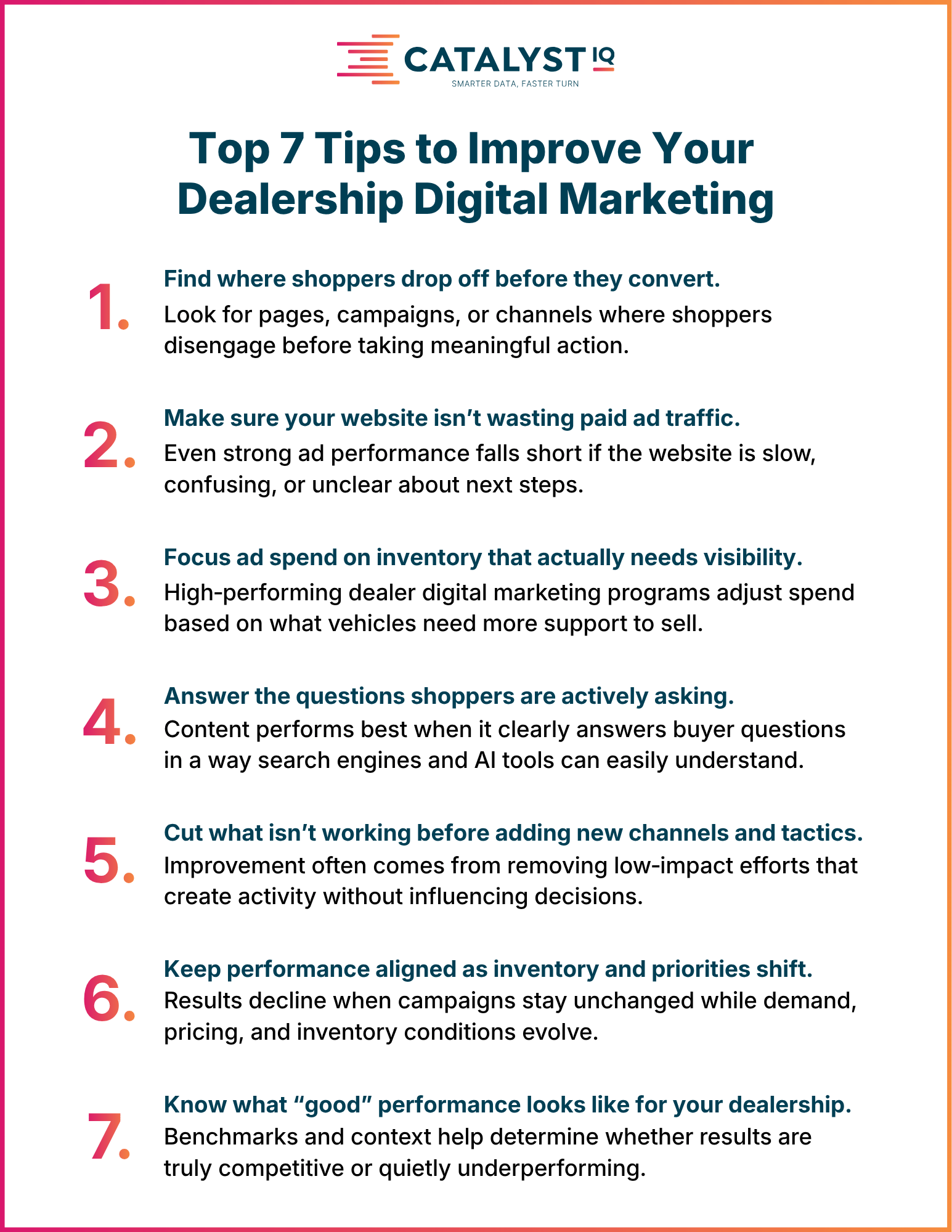
Most dealerships track traffic and leads, but fewer understand which channels and pages contribute to real buying behavior. Start by isolating where shoppers drop off: slow pages, high‑exit VDPs, or campaigns driving clicks without conversion. These gaps often cost more than underfunded channels.
What to focus on:
If your dealership website is slow, confusing, or unclear, paid traffic will not convert even when the ads are strong. Website performance is both a conversion issue and an AI visibility issue, since search and answer engines prioritize pages that are fast and easy to parse.
What to focus on:
High-performing dealer digital marketing campaigns adjust spend based on what vehicles need more support to sell. Campaigns tied to aging, competitively priced, or high-demand inventory typically outperform generic promotions.
What to focus on:
Organic visibility increasingly comes from being referenced in answers. Content that clearly defines terms, explains comparisons, and answers “what” and “how” questions is more likely to surface in traditional search results and AI-generated summaries alike.
What to focus on:
New automotive marketing software rarely fixes foundational performance issues. In most cases, improvement comes from identifying spend or effort that looks productive on the surface but doesn’t influence real buying decisions.
This often shows up in a few familiar ways: campaigns that generate clicks but no appointments, channels that receive budget simply because they always have, or tactics that stay live even after inventory or demand has shifted.
Before adding new channels, dealerships should use clear reporting to understand which efforts actually move shoppers closer to action and which ones simply create activity without outcomes.
What to focus on:
Seeing performance data is not the same as understanding whether it’s strong or weak for your market. Without clear benchmarks, it’s easy to normalize underperformance or chase improvements in the wrong places.
Effective digital marketing decisions rely on context—how your website converts compared to similar dealerships, how your paid campaigns perform relative to market demand, and whether your results support sales velocity rather than just activity.
What to focus on:
Dealership marketing performance rarely fails all at once. It degrades slowly when campaigns run unchanged as inventory, demand, and shopper behavior evolve. Having consistent oversight—whether in‑house or supported externally—helps keep strategies aligned when teams are pulled in multiple directions.
What to focus on:
Reading about digital marketing best practices is helpful. Knowing which issues apply to your dealership right now is what actually moves the needle.
In a complimentary demo, our team will review your current digital marketing strategies to help determine where small changes could deliver the biggest impact.
You’ll walk away with a prioritized view of what to address first, what can wait, and where budget or effort is likely being wasted today.


About Catalyst IQ
Catalyst IQ is an integrated automotive marketing platform that helps dealerships make smarter decisions and sell more cars using real-time data, AI-powered insights, and expert human support. From digital advertising and web presence to SEO/AEO and engagement, every solution works together to drive measurable growth.

Long before they reach your lot, shoppers are seeing your inventory in ads and searching for answers online. This guide shows how digital...

Model Year Changeover season is here. And for dealers, waiting to support 2026s could come with a significant price tag. We are officially...

No one can tell you what your dealership's marketing will cost before looking at your market. What you spend depends on your local competition,...